
Downhole working conditions vary drastically across oilfields. While measurement-while-drilling (MWD), well testing, permanent downhole monitoring and offshore well completion impose entirely different requirements on sensor accuracy, environmental resistance and mechanical structure. Higher precision does not guarantee suitability for all applications. Only by matching parameters, mechanical structures and stability performance to specific well conditions can we eliminate common issues including measurement drift, frequent malfunctions and premature scrappage. Below are standardized selection criteria widely adopted in oilfield sites and validated by real-world application cases.
I. Match Core Performance Parameters Based on Downhole Conditions (Mandatory Selection Metrics)
1. Reserve sufficient safety margin for temperature and pressure ratings
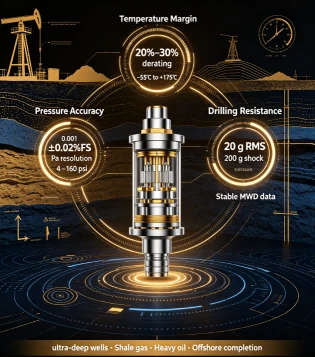
Ultra-deep wells, shale gas wells and heavy oil wells frequently experience instantaneous high-temperature and high-pressure surges. Sensors shall never be sized to the absolute limit of operating parameters.
Field standard: Actual operating temperature and pressure shall be 20%–30% lower than the sensor's rated maximum values.
Recommended specification for mainstream deep wells: Rated temperature range of -55℃ to +175℃ and rated pressure range of 0–100 MPa. This fully covers extreme operating environments of 155℃ and 98 MPa in 5,800-meter ultra-deep wells, preventing parameter drift and hardware failure under severe HPHT conditions.
2. Select accuracy and resolution according to application scenarios
MWD, precision well testing and reservoir evaluation: High-precision models are mandatory, with static accuracy of ±0.02%FS and pressure resolution of 0.001 Pa. Such sensors accurately capture tiny formation pressure fluctuations ranging from 9 to 160 psi, enabling precise identification of thin pay zones, interlayer channeling and reservoir heterogeneity to support geological modeling and reserve assessment.
Permanent downhole monitoring, intelligent well completion and water injection surveillance: Long-term stability takes priority. Required annual drift rate is less than 0.02%FS, with a temperature drift coefficient of ±0.0015%FS/℃. This eliminates measurement deviations induced by long-term temperature fluctuations downhole, delivering stable, calibration-free operation for months or even years.
3. Vibration and shock resistance for dynamic drilling operations
MWD operations are subject to constant intense mud impact and mechanical vibration, which may cause loose internal components and erratic readings in conventional sensors.
Mandatory selection threshold: Vibration resistance of 20 g RMS and shock resistance of 200 g. Sensors meeting this standard maintain continuous, undistorted pressure measurements throughout harsh dynamic drilling cycles.
II. Match Mechanical Structure & Manufacturing Process by Operation Scenario (Key Pitfall Avoidance Tips)
 1. Ultra-deep well MWD & dynamic drilling applications
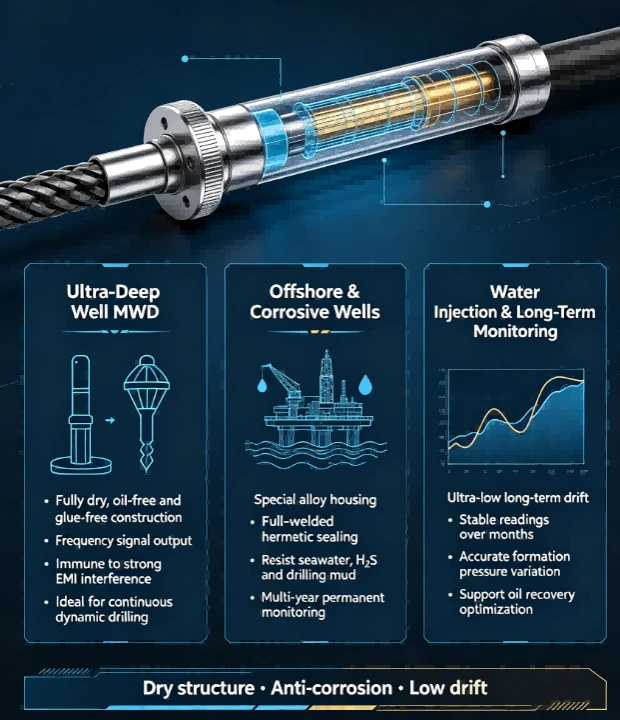
Fully dry, oil-free and glue-free construction is a must. Oil-filled sensors suffer from fluid leakage, material aging and aggravated temperature drift under downhole HPHT conditions. In contrast, dry quartz crystal designs carry zero risk of filling medium degradation. Equipped with frequency signal output, they offer inherent immunity to strong downhole electromagnetic interference, ideal for continuous dynamic drilling.
2. Offshore oilfields, highly corrosive & high-water-cut wells
Thoroughly verify packaging materials and anti-corrosion performance. Sensors built with special alloy housings and full-welded hermetic sealing are preferred, as they withstand combined corrosive media including seawater, hydrogen sulfide and drilling mud. This prevents moisture and corrosive fluid ingress, supporting multi-year permanent monitoring offshore.
3. Mature oilfield water injection & long-term static monitoring
Extreme dynamic vibration resistance is unnecessary here. The core demand lies in ultra-low long-term temperature and measurement drift. Consistent readings over consecutive months accurately reflect formation pressure variations after water injection adjustment, providing reliable data to optimize oil recovery efficiency.
III. Ultimate Selection Principles for Oilfield Field Applications
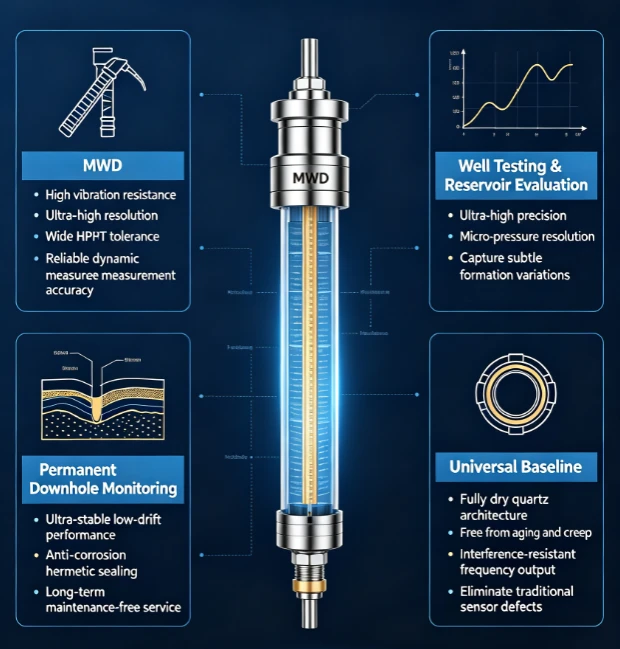
MWD: High vibration resistance + ultra-high resolution + wide HPHT tolerance, prioritizing reliable dynamic measurement accuracy
Well testing & reservoir evaluation: Ultra-high precision + micro-pressure resolution for capturing subtle formation variations
Permanent downhole monitoring / intelligent completion: Ultra-stable low-drift performance + anti-corrosion hermetic sealing, focused on long-term maintenance-free service
Universal baseline for all scenarios: Fully dry quartz crystal architecture free from aging and creep, with interference-resistant frequency output to eliminate inherent defects of traditional sensors
IV. Pitfall Avoidance Guide for Sensor Selection
Avoid blind pursuit of overrated nominal specifications and reject products with falsified parameter labels. Prioritize sensor models validated through real deployments in deep onshore wells and offshore oilfields. Only sensors whose specifications fully align with well conditions can balance accuracy, stability and service life, effectively cutting downhole operation and maintenance costs and boosting overall oilfield development efficiency.