
Downhole pressure serves as a core fundamental parameter for reservoir evaluation, productivity analysis, production regulation and safety operation and maintenance. As the key instrument for acquiring formation pressure data, the measurement accuracy, stability and reliability of downhole pressure gauges are completely determined by the performance of core sensing components. In the fields of oilfield logging, well testing and dynamic monitoring, quartz crystal pressure sensors and conventional oil-filled silicon piezoresistive pressure sensors are two mainstream core components. With differentiated technical characteristics and performance advantages, they cover high-precision precision testing and cost-effective large-scale monitoring scenarios respectively, fully meeting the downhole pressure measurement requirements of diverse well conditions and operating demands, and acting as critical core components for efficient oil and gas field development.
I.Quartz Crystal Pressure Sensor: Benchmark for High-Precision Downhole Pressure Measurement
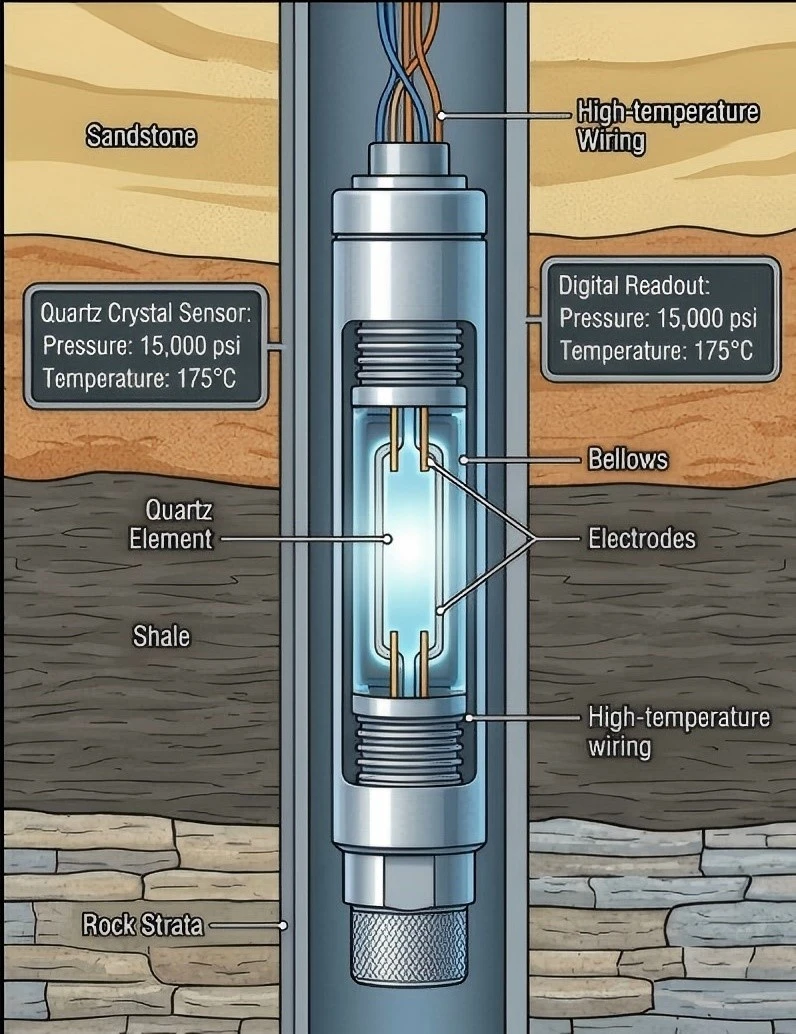 As the standard core component of high-end downhole electronic pressure gauges, the quartz crystal pressure sensor operates based on the single quartz crystal resonance principle. It converts pressure values through precise changes in crystal resonance frequency under pressure, and adopts an independent quartz temperature crystal oscillator for full-temperature accurate temperature compensation. It fundamentally avoids signal drift issues of traditional sensing elements and serves as the technical benchmark for high-precision well testing and formation dynamic monitoring in the oil and gas industry.
1. Core Technical Advantages
- Ultra-high Measurement Accuracy and Resolution: Adopting digital frequency signal output without analog signal noise interference, it achieves a measurement accuracy within 0.05%FS and a resolution up to 0.001 psi. It can accurately capture tiny formation pressure fluctuations, perfectly adapting to high-precision operation scenarios such as pressure buildup testing and fine productivity evaluation, and providing accurate data support for reservoir parameter analysis and remaining oil distribution assessment.
- Extreme Long-term Stability and Ultra-low Drift: The single quartz crystal features stable physical properties with minimal elastic hysteresis and creep coefficient. Its annual long-term drift is lower than 0.02%FS, with no obvious zero offset after long-term downhole static placement. It supports continuous monitoring for several days to months and thoroughly eliminates data distortion in long-term well testing.
- Excellent Temperature Adaptability and Anti-interference Capability: Equipped with a dual-crystal oscillator temperature compensation structure, it maintains stable measurement under complex downhole temperature variations ranging from -20℃ to 175℃ with excellent full-temperature linearity. Digital frequency signal output delivers strong resistance to electromagnetic interference and downhole environmental disturbances, suitable for high-precision data acquisition in deep wells and complex working conditions.
2. Core Application Scenarios and Industrial Value
Featuring high precision, superior stability and ultra-high resolution, this sensor is mainly applied in high-end downhole electronic storage pressure gauges, precision well testing pressure gauges, and oil and gas reservoir dynamic monitors. It is widely used in exploration well testing, pressure buildup testing, fine formation productivity evaluation, and oil and gas reservoir dynamic tracking. It acts as a core technical guarantee for obtaining accurate geological data, optimizing development schemes and improving recovery efficiency in oil and gas field exploration and development, and is the standard configuration for high-end precision downhole pressure measuring equipment in the industry.
II. Conventional Oil-filled Silicon Piezoresistive Pressure Sensor: Cost-Effective Core for Large-Scale Downhole Monitoring
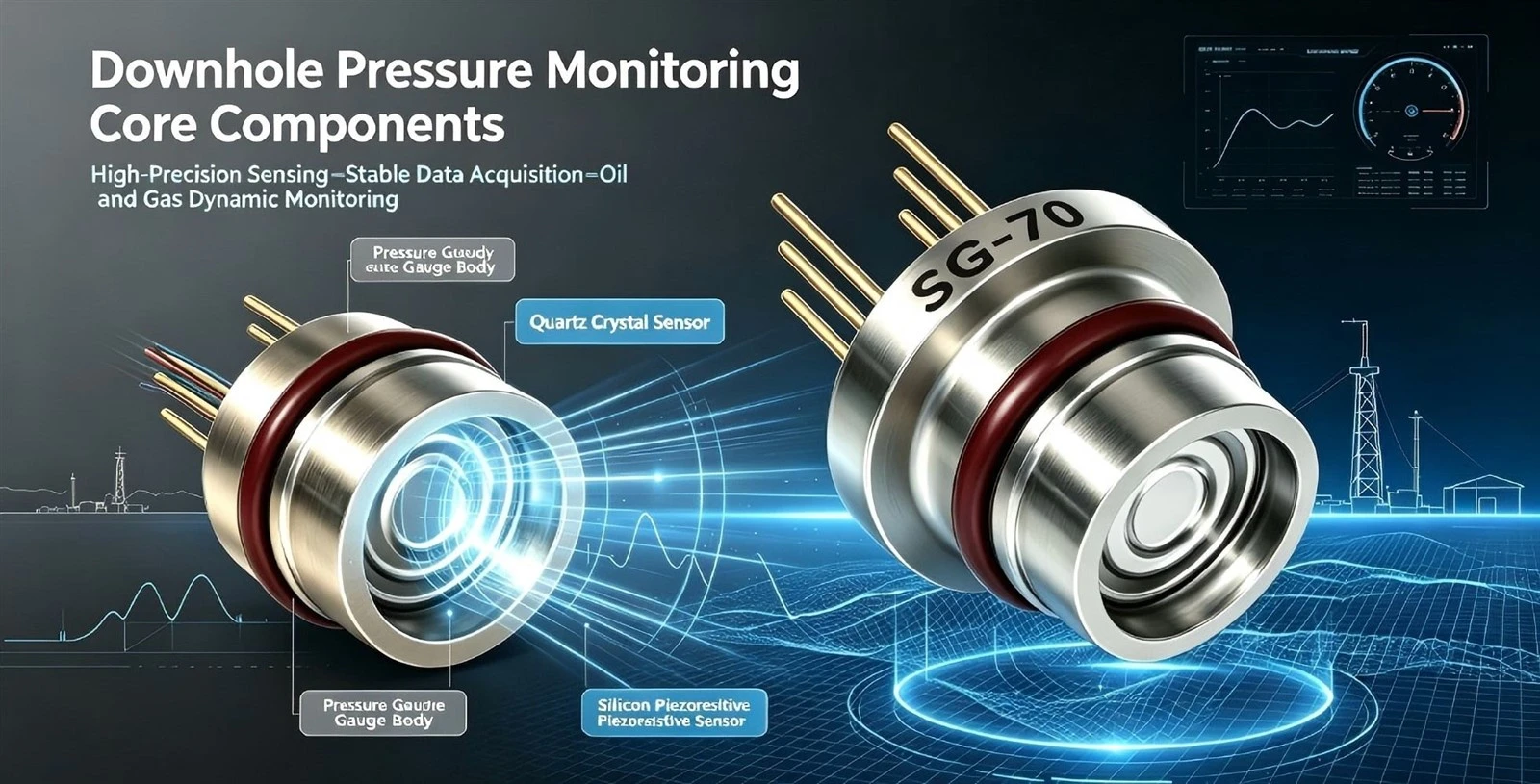
As the core component of economical downhole pressure gauges, the conventional oil-filled silicon piezoresistive pressure sensor works based on the semiconductor piezoresistive effect and Wheatstone bridge principle. It adopts a stainless steel/Hastelloy isolation diaphragm and high-temperature oil-filled structure to isolate corrosive downhole oil and gas media, and converts pressure changes into standard voltage analog signals. With a compact structure, high cost performance and wide adaptability, it has become a mainstream choice for medium and low-end oilfield monitoring and conventional well condition operations.
1. Core Technical Advantages
- Compact Structure and Strong Environmental Adaptability: The miniature and highly integrated chip core adapts to the narrow barrel structure of downhole instruments, facilitating the miniaturization and lightweight design of pressure gauges. The oil-filled isolation structure effectively isolates corrosion from water, oil and gas media, adapting to complex medium environments in conventional oil and gas wells.
- Excellent Vibration and Impact Resistance with Wide Working Condition Adaptability: Without precision resonant crystal structures, it boasts high mechanical strength and outstanding resistance to vibration, overload and impact. It adapts to complex working conditions such as continuous pumping unit vibration, downhole operation disturbance and short-term pressure overload, with higher on-site fault tolerance.
- Simple Circuit and Outstanding Cost Performance: It outputs standard millivolt analog signals with simple supporting acquisition circuits, low development and maintenance costs. With mature mass production technology and stable supply, its overall cost is far lower than that of quartz crystal sensors, making it ideal for large-scale batch deployment.
- Fast Response and Full-range Coverage: It features a fast dynamic response speed for accurate instantaneous pressure change capture. Its pressure range fully covers conventional shallow and medium-depth oilfield wells with flexible customization and strong universality.
2. Core Application Scenarios and Industrial Value
Highlighting strong adaptability, low cost and high reliability, this sensor is widely applied in economical downhole pressure gauges, real-time well monitoring pressure instruments, simple well testing equipment and routine oilfield pressure inspection devices. It serves conventional pressure monitoring of medium and shallow wells, daily working condition monitoring of production wells, normalized operation and maintenance of batch wells, and short-term simple pressure testing. It effectively reduces the cost of large-scale oilfield monitoring, ensures stable daily production of oil and gas fields, and serves as a fundamental core component for normalized production monitoring.
III. Dual-Core Complementation: Empowering the Full-Spectrum Downhole Pressure Measurement System
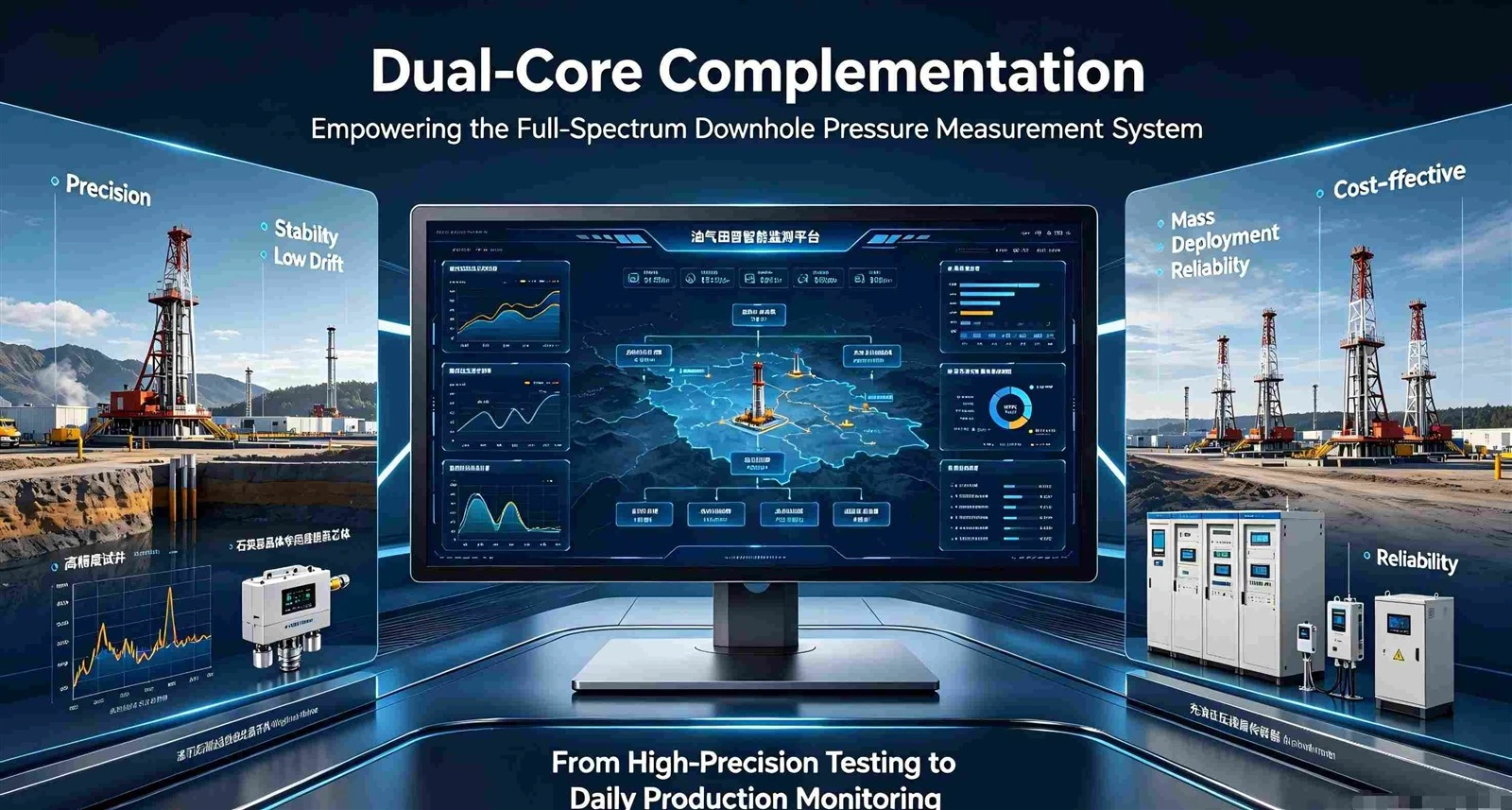
The quartz crystal pressure sensor and conventional oil-filled silicon piezoresistive pressure sensor are not in a substitute relationship, but form a matched high-low grade and scenario-complementary combination, jointly building a complete technical system for downhole pressure measurement in oil and gas fields.
Featuring high precision, superior stability and low drift, quartz crystal pressure sensors support high-precision oilfield exploration, fine well testing and in-depth reservoir analysis, providing accurate data support for oilfield scheme optimization and efficient resource development. With the advantages of low cost, strong adaptability and high reliability, conventional oil-filled silicon piezoresistive pressure sensors meet the demands of large-scale, normalized and low-cost production monitoring, establishing a solid safety line for daily oilfield production.
With differentiated performance positioning, the two core sensors fully cover the whole-process pressure measurement scenarios of oil and gas field exploration, development, production and operation and maintenance, acting as the core cornerstone for the functional realization of downhole pressure gauges and the intelligent, efficient and refined development of oil and gas fields.