
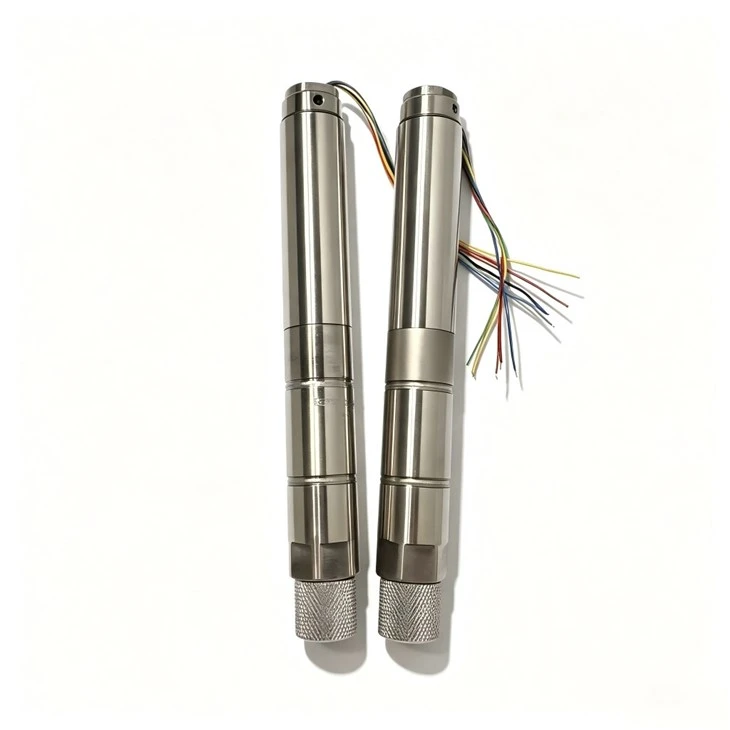
High Accuracy Quartz Crystal Pressure Transducers
2. 0.01% FS repeatability
3. 0.02% FS accuracy
4. <100Pa resolution
5. Rapid response to pressure temperature transients
Send Inquiry
Product Details
Products Description
Our SG‑HP Series high‑precision quartz crystal pressure sensor adopts high‑purity quartz crystal as the sensing core. Based on the piezoelectric effect, it measures pressure through the linear shift of resonant frequency under stress, taking advantage of quartz's inherent physical stability and noise‑resistant frequency‑output characteristic.
Built for ultra‑high‑precision measurement within harsh, mission‑critical environments, the sensor achieves ±0.02%FS accuracy and annual drift below 0.02%FS under extreme temperature, severe vibration and corrosive media. All‑metal hermetic packaging together with proprietary temperature‑compensation algorithm delivers consistent full‑range response, zero hysteresis and strong anti‑interference performance.
The sensor housing is made of Inconel 718 and bellows of Inconel 625. These high‑performance superalloys provide outstanding resistance to corrosion, high pressure and extreme heat for long‑term reliable operation.
Typical applications include oil‑gas HPHT downhole operations, subsea monitoring, pressure‑calibration systems and high‑end industrial scenarios.

Key Features & Advantages
High‑Grade Measurement Performance
Ultra‑high accuracy: ±0.02% FS for demanding precision‑critical measurements
Superior long‑term stability: Low time‑dependent drift enabled by quartz resonant sensing principle
High resolution: Detects subtle pressure variations down to 100 Pa
Fast response to pressure and temperature transients
Robust Environmental Adaptability
Excellent resistance to high temperature, vibration, shock and corrosive media; no external shock‑mounting required
Broad pressure coverage, adaptable from low‑pressure to ultra‑high‑pressure working conditions
Signal & Processing Capability
Native quartz‑based frequency output, delivering strong noise immunity and supporting long‑distance signal transmission
Built‑in digital temperature compensation for reliable temperature readout

Typical Applications
· Intelligent completion
· Cased hole logging
· MWD
· Formation testing
· Subsea wellhead monitoring
· Pressure calibration standards
· Deep sea testing

Table 1: Specifications
|
Characteristic |
Parameter |
|
Voltage requirements |
4-5.5VDC |
|
Current |
2-3mA typical, (depend on load conditons) |
|
Warm-up time |
≤1 sec |
|
Supply Voltage sensitivity |
Minimal within specified voltage |
|
Signal Outputs |
DC coupled advanced CMOS, |
|
2.8(±0.25)V p-p rectangular wave |
|
|
25% minimum duty cycle |
|
|
50 ohm output impedance |
|
|
Nominal pressure frequency |
10 kHz to 90 kHz |
|
Nominal temperature frequency |
10 kHz to 90 kHz |
|
Electrical connections |
Pressure, temperature, reference, power, ground |
|
Proof pressure |
120% full scale |
|
Gravity/ Orientation effect |
Negligible |
|
Acceleration sensitivity (any axis) |
<0.02 psi/g |
|
Mechanical shock |
500 g, 2 ms half-sine |
Table 2. Performance Specifications (Pressure)
|
Characteristic |
Parameter |
|
Sensor |
Thickness shear mode quartz resonator |
|
Nominal sensitivity |
330Hz/Mpa |
|
Achievable Resolution |
<100pa |
|
Repeatablity |
0.01%FS |
|
Calibrated temperature range |
75 to 350°F (25 to 175°C) |
|
Linearity over calibrated temperature range |
0.02%FS |
|
Response time to FS step |
<1 sec for 99.5% FS |
|
Zero drift (aging) at 15 psi, 25°C |
0.01%FS/yr |
Table 3. Performance Specifications (Temperature)
|
Characteristic |
Parameter |
|
Sensor |
Thickness shear mode quartz resonator |
|
Resolution |
<0.005°C |
|
Repeatability |
<0.01°C |
|
Accuracy |
±0.5°C |
Table 4. Absolute Maximum Ratings
|
Supply Voltage(VCC)1 |
-0.5 V to 6.0 V @ 20 mA max |
|
Pressure Output |
-0.5 V to Vcc+0.5 V @ 20 mA max |
|
Temperature Output |
-0.5 V to Vcc+0.5 V @ 20 mA max |
|
Reference Output |
-0.5 V to Vcc+0.5 V @ 20 mA max |
|
Storage Temperature |
-40°C to 175°C |
Table 5. Electrical Characteristics
|
Min |
Typ |
Max |
|
|
Recommended Operating Temperature |
0°C |
175°C |
|
|
Recommended Supply Voltage (VCC) |
4.0(Battery 3.2)V |
5.0(Battery 3.7)V |
|
|
lcc (30°C, Vin=4.0V) 4 |
1.8mA |
2.25mA |
2.8mA |
|
Supply Voltage Sensitivity |
0.15Hz/V |
||
|
Start-up Time |
75mS |
300mS |
|
|
Output Low (VOL) 5 |
0.5V |
0.5V |
|
|
Output High (VOH) 5 |
3V |
3V |
|
|
Pressure Frequency 2,5 |
10kHz |
100kHz |
|
|
Temperature Frequency 2,5 |
10kHz |
100kHz |
|
|
Reference Frequency5 |
7.193MHz |
7.2MHz |
7.207MHz |
|
Pressure Duty Cycle |
40% |
50% |
|
|
Temperature Duty Cycle |
40% |
50% |
|
|
Reference Duty Cycle |
40% |
50% |
|
|
Load Capacitance 3 |
300pF |
||
|
Load Resistance 3 |
1kΩ |
||
|
Output Coupling |
Series DC @ 50 Ohms |
||
Working Principle of pressure sensor
1. Piezoelectric Effect and Resonant Characteristics of Quartz Crystal
Quartz crystal (SiO₂) has positive and negative piezoelectric effects due to its special structure, and its piezoelectric effect is anisotropic. AT-cut wafers are commonly used to achieve optimal efficiency. Its resonant characteristics are the key to high-precision detection; the excitation voltage causes the wafer to resonate, and pressure changes will lead to regular shifts in its resonant frequency, which is the core basis for quantitative pressure detection.
2. Core Components of the Sensor
The core components of a quartz crystal pressure sensor include a quartz resonator, a force-receiving mechanism, an electrode system, and a sealed housing. It is divided into integral and separate types (the integral type is more commonly used). Each component performs its own function, realizing pressure-frequency conversion, pressure transmission, signal excitation and pickup, and internal component protection respectively.

3. Working Process:
➊Pressure Transmission: The external measured pressure is uniformly transmitted to the quartz wafer through the force-receiving mechanism, causing it to produce nanoscale elastic deformation and changing the internal stress and thickness shear modulus of the wafer.
➋Vibration Excitation: An alternating voltage is applied to the excitation electrode, which drives the wafer into a resonant state by using the inverse piezoelectric effect. When the excitation frequency matches the natural frequency of the wafer, the vibration is the most stable.
➌ Frequency Shift: Pressure changes cause regular shifts in the resonant frequency of the wafer; the greater the pressure, the higher the frequency. The shift amount has a linear correlation with the pressure value, which accurately reflects the pressure magnitude.
➍ Digital Output: The pickup electrode detects the frequency shift signal, which is amplified and shaped by the built-in signal processing circuit, and then directly outputs a digital frequency signal proportional to the pressure. It can be directly connected to a data acquisition system to realize high-precision pressure detection.

Why Choose Our Quartz Crystal Pressure ?
Ultra-High Precision & Resolution
Typical accuracy reaches ±0.01% FS, with resolution down to the one-part-per-million (ppm) level, enabling the capture of extremely pressure fluctuations.
Ultra-Low Temperature Coefficient & Wide Temperature Range
Operates across a wide temperature range of -55°C to +125°C, featuring ultra-low temperature drift of ±0.01% FS/°C, ensuring stability even in extreme environments.
Excellent Long-Term Stability
Boasts an annual drift rate of <0.02%. Combined with all-metal hermetic packaging and an independent temperature compensation algorithm, it guarantees consistent response across the full measurement range, no hysteresis, and strong anti-interference capability. Eliminating the need for frequent calibration, it offers a long service life of over 10 years.
High Anti-Interference & Reliability
Outputs a frequency signal, providing exceptional immunity to electromagnetic interference (EMI). Its fully solid-state and sealed structure delivers superior resistance to shock, vibration, corrosion, and radiation.

Quality & Testing
Strict Raw‑material Control
Each quartz crystal wafer, metal housing and electronic component undergoes incoming inspection. Only qualified raw materials are allowed for assembly, eliminating risks from the source.
Precision Assembly
Sensors are assembled in controlled environment. Every unit is assembled, calibrated and inspected by experienced technicians to guarantee consistent product performance.
Multi‑dimensional Performance Testing
Every finished sensor must pass full‑item tests before delivery:
Pressure accuracy & linearity calibration
High‑temperature aging test
Vibration & shock resistance test
Long‑term stability drift test
Hermetic sealing & insulation test
Traceable Calibration
Each sensor is supplied with test data record. Calibration records are traceable, supporting customer on‑site verification.
Final Visual & Function Audit
100‑percent final inspection for appearance, wiring and signal output. Products will be packed only after all test indicators meet specification.


Q: Is a shock absorption device required when used downhole?
A: Our equipment adopts a high-strength protective structure and has passed rigorous downhole working condition tests. It can sufficiently resist complex downhole environments such as strong vibration and impact, with stable and reliable performance. It can be safely put into use in oil wells without the need for additional shock absorption equipment.
Q: Are quartz pressure sensors suitable for harsh environments?
Yes,absolutely! This pressure sensor is specially developed and manufactured for the extremely harsh working conditions encountered in oil well downhole environments. It is precisely engineered to withstand the complex challenges of high temperature, high pressure, high corrosion, and severe vibration. Capable of operating stably in severe conditions and accurately capturing pressure data, it fully meets the stringent requirements for pressure monitoring in downhole operations, providing reliable assurance for the safety and efficiency of downhole operations.
Q: What are the operating temperature and pressure range specifications available for sensors designed for downhole oilfield applications?
A: The sensor offers a wide range of temperature and pressure options. For temperature, the common models include 150°C and 175°C. For pressure, we provide three standard ratings: 70MPa, 100MPa, and 140MPa. Customers can freely select the appropriate specifications based on their actual downhole operational requirements to ensure perfect matching with site conditions and guarantee accurate and reliable measurement data.
Specifically, the 150°C/100MPa and 175°C/100MPa combinations are the most widely used. They are precisely engineered to match the typical high-temperature, high-pressure downhole conditions. Extensively verified through field applications, they offer optimal stability and accuracy, directly meeting the core needs of downhole pressure monitoring. They represent the top choice for high cost-performance in engineering selections.
Hot Tags: high accuracy quartz crystal pressure transducers, China high accuracy quartz crystal pressure transducers manufacturers, suppliers, factory, High Accuracy Quartz Crystal Pressure Transducers, pressure sensor, High precision crystal pressure sensor, pressure downhole gauge, crystal pressure sensor
Previous
No InformationNext
No InformationSend Inquiry
