
1. Why downhole north-finding is hard
Measurement-while-drilling (MWD) and logging-while-drilling (LWD) tools must answer a basic question in real time: which way is the borehole pointing? The reference is geographic true north. The conventional solution is a fluxgate magnetometer sensing the geomagnetic field's pull toward magnetic north, followed by declination correction. The weakness of this route is that downhole is a world of steel: drill collars get magnetized through machining and service, and adjacent casing and magnetic formations bend the local field. The industry workaround is to run sensors inside a non-magnetic collar, but the non-magnetic window is limited, its magnetization drifts over years of service, and declination itself varies by location and over time. There is a subtler catch: at high latitudes the horizontal component of the geomagnetic field weakens, and magnetometer azimuth degrades with it - the same tool performs worse in northern fields than near the equator. As pad sites get denser and anti-collision windows narrower, those errors get more expensive every year.
2. Gyro north-finding: trust only Earth's rotation
A gyroscope offers a reference that has nothing to do with magnetism. Earth rotates at about 15°/h; its horizontal projection at latitude φ is ωh = 15°/h·cosφ, always pointing at true north. Project this invisible compass onto two orthogonal sensing axes, and the azimuth follows directly: ωx = ωh·sinα, ωy = ωh·cosα, so α = atan2(ωx, ωy). Magnetized collars, casing, magnetic formations, magnetic storms - none of it matters.
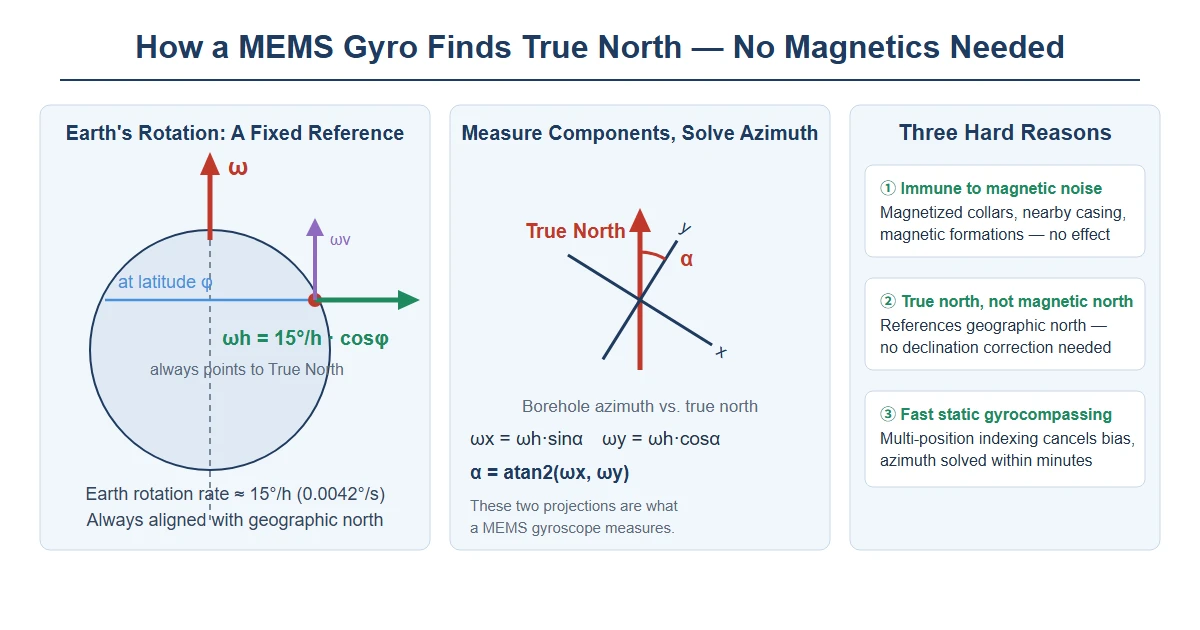
Fig. 1 MEMS gyro north-finding: measure the horizontal component of Earth's rotation, and true-north azimuth follows
3. Multi-position indexing: rotate the bias away
Honesty first: a single MEMS gyro carries a bias of a few degrees per hour - larger than the 15°/h signal itself, so a "single reading" is doomed. The real answer is indexing: let the gyro rotate about the borehole axis in 90° steps and stop at four positions. Taking the difference between readings 180° apart, ω(α) − ω(α+180°) = 2·ωh·cosα - the bias, being a DC term, cancels exactly, while the signal doubles. With temperature compensation and multi-cycle averaging, an azimuth reference of 0.25°–0.5° is obtained within minutes. North-finding time and accuracy are a tunable pair: stop longer, average longer, and the azimuth settles tighter.
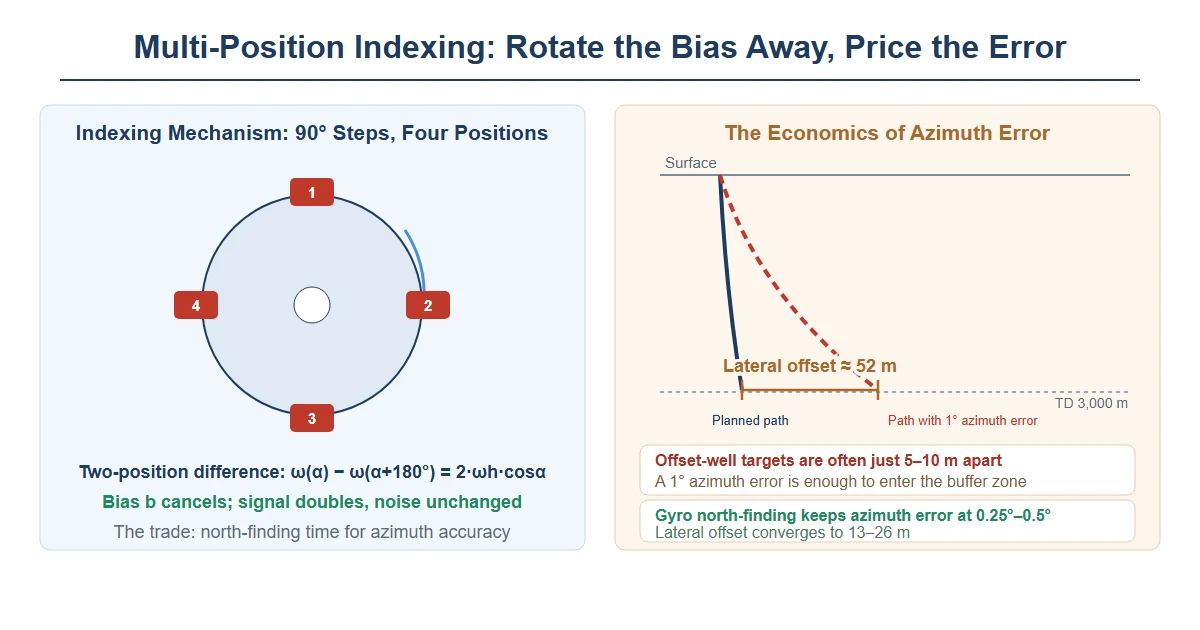
Fig. 2 Multi-position indexing and the economics of azimuth error: error grows linearly with depth
4. Why MEMS
Ring-laser and fiber-optic gyros are accurate, but their size, power and price do not fit downhole tools; spinning-rotor gyros cannot tolerate shock and vibration. A MEMS gyro is a micromachined silicon resonator: it has no spinning rotor and is naturally shock-tolerant - the violent vibration of a mud motor is its home turf; its millimeter-scale size fits the tight radial space of an MWD probe; it draws little power, needs only simple temperature sensing, and with high-temperature packaging it runs beyond 150 °C. Cost makes the argument complete: batch MEMS manufacturing is what makes "one gyro north-finding module per probe" economically realistic for the first time.
5. The economics of azimuth error
Azimuth error is invisible on the rig floor, yet it grows linearly with depth: 1° of azimuth error at 3,000 m TD means a lateral offset of roughly 52 m, while offset-well and SAGD pair targets are often just 5–10 m apart. That is the value proposition of gyro north-finding:
Pad drilling and dense well sites: magnetics-free azimuth puts anti-collision scans on a sound footing;
Near casing and magnetic formations: seamless takeover where magnetometers fail;
Sidetracks and relief wells: initial azimuth calibration that does not propagate error downstream;
High-latitude fields: where the magnetic route fades, the gyro route does not.
In practice this is not "gyros replacing magnetometers" but a division of labor: the gyro anchors the starting point and the check points; the magnetometer carries the continuous surveys while drilling; each cross-checks the other.
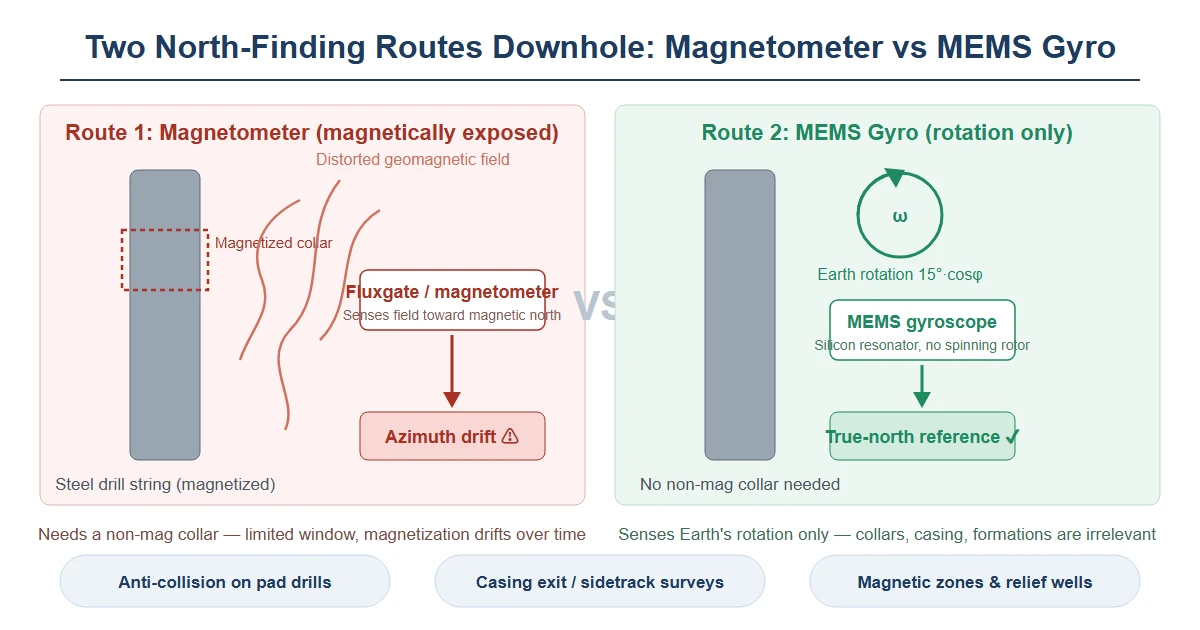
Fig. 3 Two routes downhole: magnetometers depend on the magnetic environment; MEMS gyros trust only Earth's rotation
6. Bottom line
North-finding is about a reference that never drifts with the environment. Man-made steel distorts the geomagnetic field; Earth's rotation does not. As MEMS processes, high-temperature electronics and indexing mechanisms mature, making gyro north-finding a standard module in the MWD/LWD bottomhole assembly is turning from an option into a requirement.